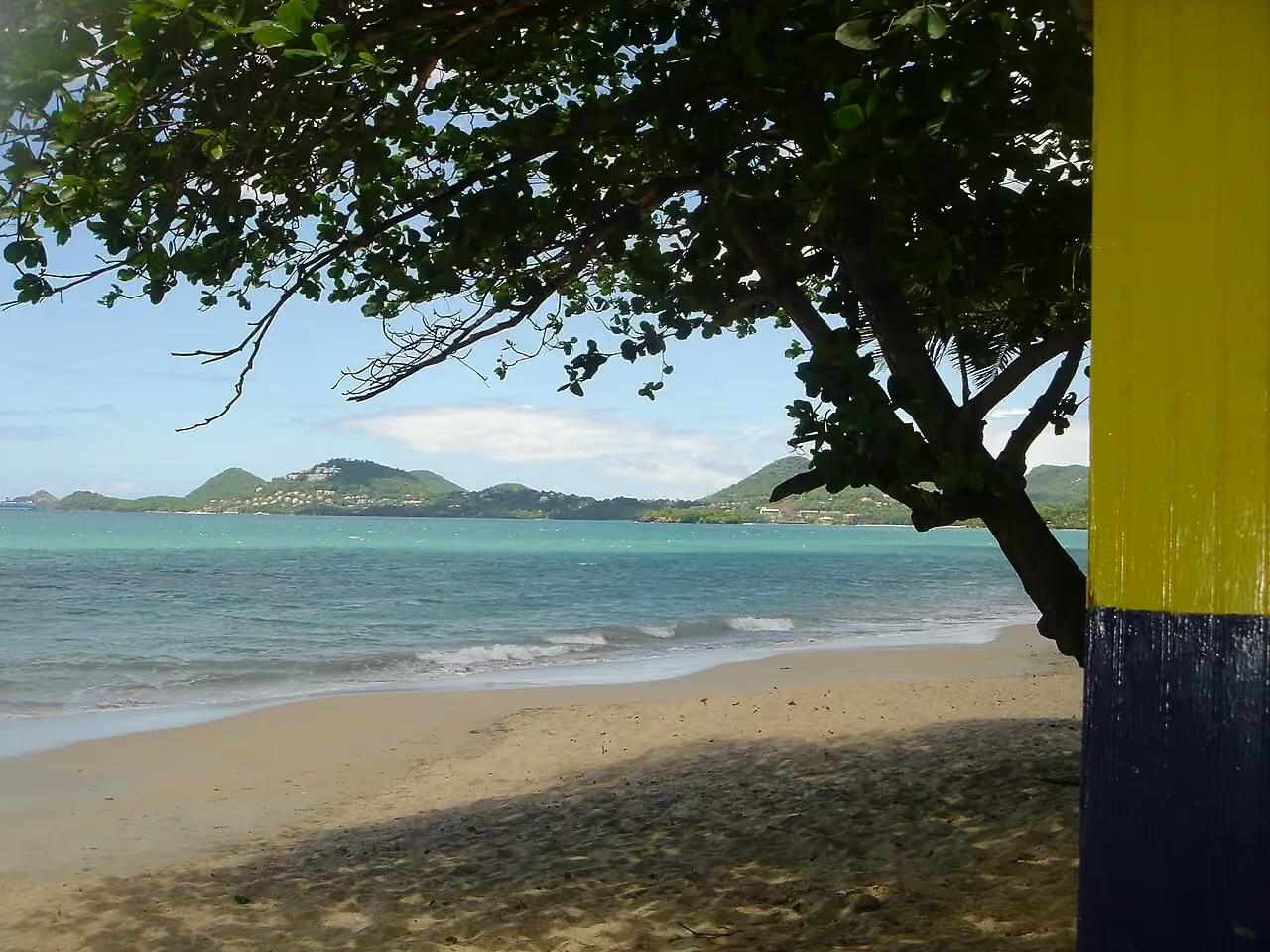
About the spot
Cas en Bas, also known as Cotton Bay, is located on the Atlantic side of northern St. Lucia, near the Gros Islet. The C-shaped bay is covered by the outer reef: inside the water is calmer, the ocean wave is already felt outside. The north is convenient because the kite beach can be combined with the housing and evening life of Rodney Bay, and the shore itself remains quite different in mood - with trees and the ocean horizon. There are Aquaholics and Kitesurfing St Lucia; check your current launch point and opening hours before you travel.
What to pay attention to
Watch out for coral and sea urchins here. Ask an instructor to show you the reef, depth, channels and safe entry. Do not step on coral or approach the reef edge without local guidance.
Reef changes the nature of spot
Cas en Bas is a C-shaped bay on the Atlantic coast. Kitesurfing St Lucia describes an outer reef that separates the calmer inland water from the ocean wave. It is this contrast that makes the place interesting: next to the ocean there is a protected water area.
But protection from the wave does not mean the absence of obstacles. There are corals and hedgehogs here. Before the first exit, ask to show the safe approach, the boundaries of shallow water and the reef area. Do not explore the bottom at random and do not step on corals. When choosing a lesson, it is useful to ask where the bodydrag takes place and how you will be returned to the start.
Aquaholics: school, rental and local team
Aquaholics is located in Cas en Bas/Cotton Bay. In its own description on Tripadvisor, the school specifies lessons with accompaniment on a jet ski, rent and kite trips. This format of assistance on the water should be discussed in advance: ask what is included in the lesson and whether the rescue is valid for self-kitesurfing.
Phone number listed on school cards: +1 758 726 0600. A separate website, aquaholicsstlucia.com, could not be opened during the inspection, so the link in the block of schools leads to her Tripadvisor card. Current opening hours, prices, free kite sizes and availability of rental for the desired dates require direct confirmation.
Another school on this bay.
Don't confuse the titles. Kitesurfing St Lucia Northern school in Cas en Bas, and stluciakitesurfing.com - The Reef website in the south. The northern school has published introductory and individual lessons, classes with a boat and rental for experienced riders. Before issuing equipment, basic skills and use of the security system are checked.
| Kitesurfing St Lucia: published landmark | Cost, USD |
|---|---|
| Introductory class, hour | 80 |
| Boat lesson, two hours. | 180 |
| Kite and board, day | 120 |
Prices are for Kitesurfing St Lucia, not Aquaholics. Retrieved 2 October 2026; confirm before booking. Full price and conditions. School contact: +1 758 714 9589.
When to go and what to ask in advance
Kitesurfing St Lucia calls December-July the season of more reliable trade winds, highlighting mid-December-March. In July-November, the wind is described as less stable. For your own trip, check the forecast, the school schedule and the conditions for cancellation of classes in inappropriate weather. Description of the season at a local school.
In the letter to the school, specify your level, weight, dates and task: first starts, confident upwind, rental or training. Separately ask about the depth, corals, safe passage, boat or jet ski and storage of your equipment. Accommodation near a beautiful Caribbean beach won’t necessarily be near the Atlantic kite start.
Green island outside kite beach
The north of Saint Lucia is comfortable living in two rhythms. In the daytime, the wind and the bay behind the reef; in the evening, Rodney Bay and a return to normal island life. Cas en Bas offers a quieter side of the coast: green surroundings, walks by the ocean and a sense of space.
On a day without wind, you can choose Pigeon Island: the coast, a natural park and historical ruins. To explore the tropical greenery - the gardens and forest routes of the island. Pitons and Soufriere are located in another part of St. Lucia: it is better to allocate such a trip separately, so that the walk does not turn into a rush between transfers.
It is worth leaving a free day on the schedule. A beautiful green island is interesting not only for the number of hours on the water: sometimes the best shot of a trip is on a forested slope or the next turn of a coastal road. Comparison with the southern bay of Anse de Sables.
Detailed sources
- Local school: bay, reef and road
- Aquaholics: description of the school and photos in the card
- Saint Lucia Tourism Authority: Green areas of the island
- Parks, Gardens and Pigeon Island
How to plan the road
The base is convenient to look in the area of Gros Islet, Cap Estate or Rodney Bay, comparing the road to Cas en Bas. International Hewanorra (UVF) will require a trip across the island; northern George F. L. Charles (SLU) is closer, but serves mainly regional flights.
Before paying, check with the receiving team the place of study and the nearest comfortable accommodation. “Hotel by the sea” and “hotel by the kite zone” do not always mean the same thing.
Where is it?
The marker shows the area, not the exact launch point. Find the station address and permitted area at the school.
Questions before travel
How to choose the time of the trip?
December-July; often mid-December-March is a benchmark for planning. Before paying, confirm the season at the local school and check the forecast for travel dates.
What to ask the school before booking?
Where the lessons are held, what the size of the group is, whether the equipment is included, what language is taught and how the rescue on the water is organized.
Sources and relevance
The certificate was prepared on October 2, 2026. The description is not a personal testimonial of the author about the school; the availability of seats, prices and schedule specify directly.

Riders' experiences
What was the wind, where did you ride, what did you like and what is worth knowing before the trip?
What riders say
Loading reviews…